



Exploring the Impact of the Medical Imaging Standardized eReferral Form on Clinician Efficiency and Timing of Sending eReferrals
Key Takeaways
Value proposition: The Medical Imaging Standardized eReferral Form (MI SRF) has the potential to increase clinician efficiency and decrease overall time and number of clicks required to send eReferrals.
Across 3 participating clinicians and 3 scenarios (16 total time-tracked simulated referrals), findings suggest potential workflow efficiency benefits compared to existing non-standardized MI forms.
- The MI SRF:
- Reduced completion time by an average of 16 seconds (~16% reduction)
- Averages between clinicians ranged from 10 seconds longer to 44 seconds faster
- Required an average of 5 fewer clicks (~45% reduction)
- Averages between clinicians ranged from 1 to 9 fewer clicks
- Reduced completion time by an average of 16 seconds (~16% reduction)
- Participating clinicians reported potential benefits of the MI SRF, including improved formatting, ease of use, efficiency, and a more standardized approach.
Background
Referrals from primary care healthcare professionals, such as family physicians or nurse practitioners, serve as a key entry point for patients seeking specialist care (1). However, patients often face barriers in timely access to care, including long wait times for specialist appointments and subsequent treatment. In Canada, the median wait time from a referral to treatment was 28.6 weeks in 2025, compared to just 9.3 weeks in 1993 (2). These delays negatively affect clinicians, patients, and the broader healthcare system. For example, patients can experience worsening symptoms, stress, and frustration, while clinicians face increased workloads due to repeated monitoring appointments and time spent on workaround solutions (1).
One contributor to prolonged wait times is the continued reliance on known inefficient referral methods. For example, many healthcare facilities still use fax as the main method of communication among clinicians, increasing risk of errors, miscommunication, and administrative burden (3). Additionally, referrals often need to be redirected when wait times are too long or when no response is received, leading to further delays and limiting clinicians’ capacity to accept new patients (3).
Electronic referrals (eReferrals) have the potential to address these challenges and enhance access to specialist care, by streamlining referral workflows. eReferrals can reduce missing information, unnecessary referrals or follow-ups, and time spent processing referrals, helping improve wait times (4). While literature on the effectiveness of eReferral systems is promising, the evidence remains limited and warrants further research. For example, compared to paper-based methods, eReferral led to improved referral processing time and reduced wait time for patients seeking orthopedic care in Canada (5). However, research on the impact of eReferral on other specialties, such as medical imaging, is limited. Furthermore, eReferral is being continually enhanced through standardization initiatives aimed at producing consistent, clinically relevant, and high-quality forms (6). Notably, Standardized eReferral Forms (SRFs) are being developed based on rigorous environmental scans of existing eReferral forms, while embedding principles and best practices to standardize clinical and non-clinical form elements. These forms facilitate triaging and scheduling based on urgency, appropriateness, and patient preference, and present form elements in a standard, complete, and consistent way.
With the development and deployment of SRFs being a new enhancement, this is the first case study to explore the impact of the Medical Imaging SRF (MI SRF) on clinicians’ efficiency and timing of sending eReferrals, compared to their current referral workflow (e.g., existing eReferral forms and/or fax-based methods). The focus on MI SRFs is particularly relevant given the increasing demand for diagnostic and medical imaging in Canada, driven in part by the aging population (7).
Methods
This case study took place from February 12, 2026, to April 30, 2026. The case study was led by Amplify Care, with consultation and feedback from clinical advisors and collaborators from Ontario Health (OH). Clinician participants were recruited in collaboration with internal and external partners.
The data collection activities took place in a controlled setting, including demo and workflow mapping of the clinician’s referral workflows (current and MI SRF), a Time-Motion assessment, and a qualitative interview. Prior to data collection, a total of 3 mock patient scenarios were developed, each focusing on 1 scenario (MRI, CT, or X-Ray Requisition), with varying complexity.
During the Time-Motion data collection, each clinician was asked to walk through (i.e., demo) their steps for sending 1 simulated referral using Ocean eReferral (“Ocean”) for each scenario and workflow, up to, but not including, the submission step, while mimicking their real-world practices. If the clinician did not previously use the MI SRF, they were provided with a walkthrough prior to data collection. The data collection meeting was recorded, and an observer timed the overall workflows. The meeting also included a discussion facilitated by scripted interview questions to gather qualitative data on the clinicians’ experience and perceived impact of the MI SRF.
Results
A total of 3 primary care clinicians participated in the case study, with each having between 15-40 years of experience in healthcare, including 1 family physician, 1 nurse practitioner, and 1 healthcare consultant with prior experience as a physician. All clinicians used the Telus PS Suite EMR system and had current experience sending referrals using both eReferral (i.e., existing forms in Ocean) and fax workflows; 2 clinicians indicated eReferral as their main referral method, while 1 clinician indicated fax as their main method. However, the clinician who reported fax as their main method was unable to fax referrals during the case study due to technological constraints; therefore, all clinicians’ current workflows involved sending eReferrals in Ocean using an existing non-standardized MI form.
Each clinician used an existing non-standardized MI form for a receiving site they were familiar with. Because these forms varied in complexity and clinical content across receiving sites, a single representative non-standardized MI form could not be used for all clinicians. Prior to the Time-Motion assessment, 2 clinicians received a walkthrough of the MI SRF as it was their first time using the form; this walkthrough was not required for 1 clinician who had approximately 2-3 months of prior experience using the MI SRF.
Figure 1 illustrates the steps involved in clinicians’ workflows for sending eReferrals using both their current (existing non-standardized MI form) workflow and MI SRF workflow. As shown in Figure 1, both workflows involved a similar number and type of form elements overall. However, the existing non-standardized MI form included more mandatory fields, which may result in more steps and clicks compared to the MI SRF.
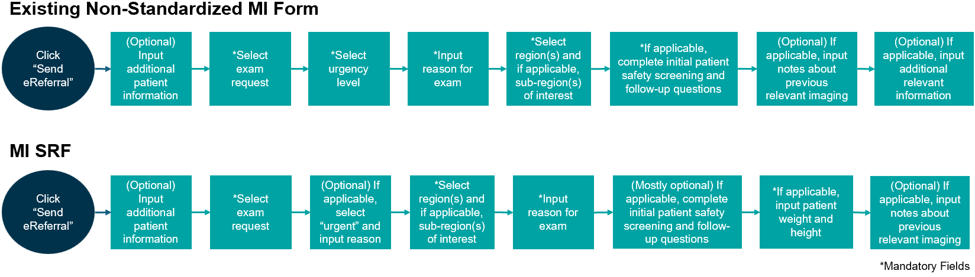
Figure 1. Existing non-standardized MI form and MI SRF sending referral workflows
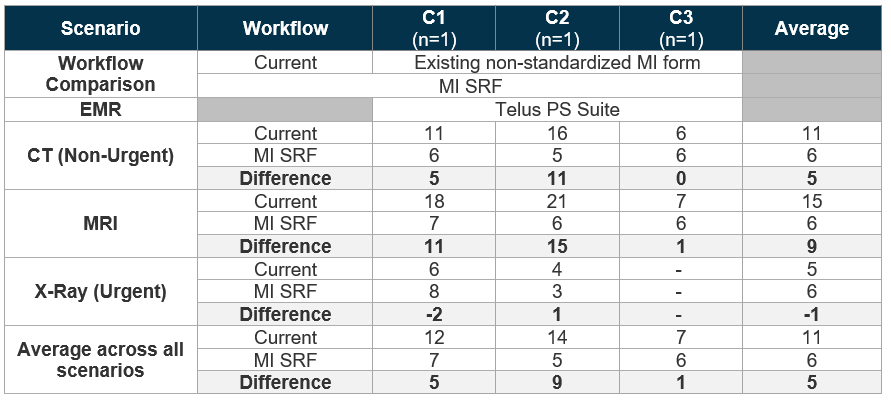
Tables 1 and 2 present the sending referral workflow times and click counts by clinician, respectively. In the X-Ray scenario, one clinician could not send a referral and noted that, instead of sending an eReferral, the patient would typically be given a paper copy of an imaging order for a walk-in X-Ray exam, therefore, this workflow could not be assessed within the case study.
On average, across all clinicians and scenarios, it took 16 fewer seconds (~16% reduction) to send a referral using the MI SRF, compared to the existing non-standardized MI form. In particular, the MI SRF took 14 fewer seconds for a CT Requisition, 37 fewer seconds for an MRI Requisition, and 2 fewer seconds for an X-Ray Requisition. However, for clinician 3, the MI SRF took more time than the existing form for each scenario, as shown in Table 1.
Similarly, the MI SRF took an average of 5 fewer clicks (~45% reduction) across clinicians and scenarios. Specifically, fewer clicks were observed in 2 of the 3 scenarios, including 5 fewer clicks for a CT Requisition, 9 fewer clicks for an MRI Requisition, and 1 more click for an X-Ray Requisition.
Table 1. Sending referral workflow times and time differences [Current – MI SRF] (seconds) by clinician
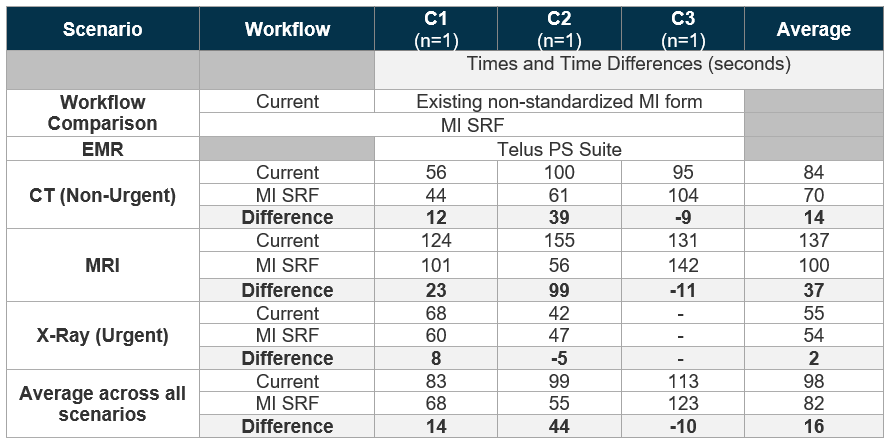
Table 2. Sending referral workflow click counts and clicks differences [Current– MI SRF] by clinician
Interview Themes
Benefits
The participating clinicians noted several benefits of the MI SRF, including its revised format, style, and layout, as well as its efficiency, ease of use, response options, and standardized approach. The ability to skip non-applicable fields was viewed positively, along with the opportunity to request that certain fields be hidden based on the receiving site’s scope of practice. The patient safety screening section was also well received, particularly as it allows clinicians to select only applicable risks rather than requiring confirmation of “No” for each item. The positioning of patient mobility-related questions (i.e., “Accessibility concerns or disability”) toward the end of the form was also appreciated.
Moreover, the standardized format and comprehensive list of questions were perceived to support more complete and accurate data collection, with potential downstream benefits including enhanced referral quality, fewer rejected referrals, and more appropriate imaging ordering for patients who meet established criteria. This approach was also viewed as having the potential to reinforce patient safety and facilitate safer and easier development of medical directives. As one clinician emphasized, “having a good referral is key, whether it is the physician or you’re creating a medical directive,” noting that “the more information you provide to a radiologist, the better.” In addition, standardization was perceived to reduce administrative burden over time by minimizing the need to track multiple form types and updated versions across institutions, while streamlining data collection through consistent information requirements. One participating clinician noted, “Standardized is better; removes the burden of having to keep up with all different forms out there.”

Standardized is better; removes the burden of having to keep up with all different forms out there.
– Participating Clinician.
Technical features
With respect to technical features, both the clinical decision support toggle and the feedback survey link embedded within the MI SRF were perceived as valuable components. However, one clinician recommended continued efforts to raise awareness of these features, noting that not all users may be aware of their availability.
Adoption and Future Usage Considerations
The clinicians identified multiple adoption considerations, including the initial transition period and adjustment to the new MI SRF layout. Specifically, in current state, specialists on the Amplify Care network may opt to maintain their existing non-standardized form rather than transition to the standardized MI SRF. As one clinician explained, “Some specialists have their own forms [and might] refuse to accept anything but their own form; will need to onboard them and ensure willingness to adopt the new SRFs.”. Overcoming this challenge will require meaningful and targeted change management support during the transition period to the MI SRF for both specialists and referring clinicians.
Overall, the MI SRF was viewed positively; 2 of 3 clinicians indicated they would be likely to use the form in the future and would recommend it to colleagues, while 1 clinician was unable to respond to this question due to time constraints.
Discussion
The introduction of SRFs within the eReferral environment demonstrates ongoing efforts to enhance both patient and clinician experience within the referral process. This case study demonstrates that, for the MI SRF in particular, participating clinicians required less time and fewer clicks on average to complete referrals across 3 patient scenarios when compared with existing MI forms. One reason for this notable difference is within the patient safety screening section, some existing non-standardized MI forms require the sender to select “Yes” or “No” on various questions before proceeding to submit the referral. Whereas, on the MI SRF, particularly for the MRI requisition, senders have the option of selecting “None of the above,” rather than interacting with all safety screening questions.
In addition, clinicians identified several key benefits of the MI SRF, including improved formatting, ease of use, efficiency, and a more standardized approach. As the MI SRF is more widely deployed across receiving sites, the value of standardization is expected to become increasingly evident in practice. By reducing variation, standardization promotes consistency, familiarity, and clearer clinical and administrative language for referring clinicians throughout the referral process.
The participating clinicians also reported sending varying numbers of referrals per day within their current workflows, with one reporting at least ~10 per day and another ~3-8 per day. Based on the average referrals sent per day across these two clinicians (~8/day) and an average 16‑second time savings per referral with the use of the MI SRF, this could result in ~2.1 minutes saved per day (range: 0.8 to 2.7 minutes per day), or ~10.7 minutes per week (range: ~4 to 13.3 minutes per week) for a primary care clinician, assuming similar findings for other SRFs.
Despite these promising findings, participants identified a key adoption consideration in the current state context. Some receiving sites may opt to maintain the use of their own existing forms in the Amplify Care network, which may limit uptake of the MI SRF. Addressing this will require targeted and structured change management support. Effective change management is critical to enable adoption for both referring clinicians and receiving sites. Without dedicated onboarding support, resistance and challenges with acceptance of standardization may persist, limiting the realization of the MI SRF’s benefits within the eReferral environment.
Limitations
There are several key limitations and future opportunities to consider when interpreting the results.
First, as this was a case study, the scale and sample size were small, which may have reduced the variety of workflows analyzed. In addition, all participating clinicians used an eReferral-integrated version of Telus PS Suite; other EMRs or direct Ocean portal use (i.e., not EMR-integrated) may impact sending time and overall referring experience. Nonetheless, this focused case study approach provides valuable insights that can inform future larger-scale evaluations with expanded sample sizes, to better capture workflow variations across different clinicians and EMRs. Such work would enable more generalizable conclusions regarding the efficiency and time savings linked with the MI SRF, as well as other SRFs more broadly.
Secondly, the MI SRF and other SRFs are still relatively new to clinicians; 2 of the participating clinicians had never used a SRF until the case study, which may have impacted workflow time and perceived impact. In addition, this case study focused only on CT, MRI, and X-Ray scenarios. Future studies may consider expanding the scope of study to other specialty pathway SRFs (e.g., Cardiology, Orthopedics, Respirology, etc.) and capturing clinician feedback after they have gained more experience with using SRFs. Particularly, in real-world contexts, primary care clinicians may be required to submit a referral to multiple specialty pathways within a single working day. To capture this real-world requirement, future studies may consider testing referrals sent to multiple specialty pathways within a single simulated scenario, in addition to rare and/or less commonly referred to specialty pathways.
Finally, real-world nuances are not captured due to the case study taking place in a controlled and test environment (e.g., in real-world practice, clinicians may pause to ask the patient questions or encounter unforeseen technical issues). During the case study, participating clinicians were also asked to “hover” over the “Send eReferral” button rather than submitting a referral; as a result, potential errors during the final submission step (i.e., clicking “Send”) such as needing to return to complete initially missed mandatory fields, could not be captured. Future opportunities include evaluating the impact of SRFs on the full end-to-end referral process, including the steps beyond the submission step, such as triaging efficiency and information completeness from the receiving site perspective, alongside any delays associated with rejected referrals.
Conclusion
This is the first case study to examine the impact of the MI SRF on clinicians’ efficiency and timing of sending eReferrals. Findings from this work suggest that using the MI SRF could reduce both the time and clicks required to send referrals, compared to existing MI forms. While promising, further evaluation is needed to more fully assess the impact of SRFs on clinician efficiency and referral timing from both sender and receiver perspectives.
Work Cited
- Marshall EG, Miller L, Moritz LR. Challenges and impacts from wait times for specialist care identified by primary care providers: Results from the MAAP study cross-sectional survey. Healthc Manage Forum. 2023 Sep;36(5):340–6. doi:10.1177/08404704231182671 PubMed PMID: 37415463; PubMed Central PMCID: PMC10448708.
- Mackenzie Moir, Nadeem Esmail. Wait Times for Health Care in Canada, 2025 Report [Internet]. Fraser Institute; 2025 Dec. Available from: https://www.fraserinstitute.org/sites/default/files/2025-12/waiting-your-turn-2025-17913.pdf
- Hajizadeh M, Jalili F. Addressing Healthcare Waiting Time Challenges in Canada: Insights From Emerging Initiatives. Int J Health Policy Manag. 2025 Sep 22;14:8986. doi:10.34172/ijhpm.8986 PubMed PMID: 41966187; PubMed Central PMCID: PMC12595564.
- Azamar-Alonso A, Costa AP, Huebner LA, Tarride JE. Electronic referral systems in health care: a scoping review. Clin Outcomes Res CEOR. 2019;11:325–33. doi:10.2147/CEOR.S195597 PubMed PMID: 31190925; PubMed Central PMCID: PMC6511625.
- Mohammed HT, Payson LA, Alarakhia M. The impact of integrating electronic referral within a musculoskeletal model of care on wait time to receive orthopedic care in Ontario. PloS One. 2020;15(11):e0241624. doi:10.1371/journal.pone.0241624 PubMed PMID: 33141866; PubMed Central PMCID: PMC7608881.
- Laing S, Jarmain S, Elliott J, Dang J, Gylfadottir V, Wierts K, et al. Codesigned standardised referral form: simplifying the complexity. BMJ Health Care Inform. 2024 Jun 19;31(1):e100926. doi:10.1136/bmjhci-2023-100926 PubMed PMID: 38901862; PubMed Central PMCID: PMC11191734.
- Greg Sutherland, Nigel Russell, Robyn Gibbard, Alexandru Dobrescu. The Value of Radiology, Part II [Internet]. The Conference Board of Canada; 2019 Jun. Available from: https://car.ca/wp-content/uploads/2025/03/value-of-radiology-part-2-en.pdf
Interested in learning more?
Interested in partnering with us or learning more about
what we can offer you? Please reach out here.
Get the latest resources and insights
-

One Click Can Make a Difference: Building Better Cybersecurity Habits
At Amplify Care, cybersecurity isn’t something we simply talk about. As leads for Shield, our…
-

Entering the AI Era: Lessons from the 2026 OMD Educates Event
Our big takeaway from OMD Educates 2026: As AI becomes more integrated into healthcare, some…
-

Fall 2026 Edition of the West Deployment Team Newsletter
Welcome to the Winter 2026 Edition of the West Deployment Team Newsletter for health professionals in the West Region! Our West Deployment…
-

Remembering Brian Sinclair: What His Story Asks of Us
Today marks National Day for Truth and Reconciliation, a time to listen, learn and reflect…