



Chronic Kidney Disease EMR Tool: A Case Study on Detecting the Risk and Facilitating Appropriate, Timely Management and Referral to Nephrology
Key takeaway
The Chronic Kidney Disease decision support EMR tool uses eGFR (estimated glomerular filtration rate) and ACR (urine albumin to creatinine ratio) values to support primary care clinicians with screening of high-risk populations for chronic kidney disease, early detection, continued patient management and timely referral to Nephrology based on chronic kidney disease risk, in order to delay chronic kidney disease progression.
In Canada, it is estimated that 12.5 per cent of the population has chronic kidney disease,1 but the condition is often under-recognized by primary care clinicians.2 Due to the silent nature of the condition, the Ontario Renal Network recommends early identification and prevention of end-stage renal disease with screening of patients with risk factors for chronic kidney disease, which include patients with diabetes mellitus, hypertension, and those aged 60-75 with cardiovascular disease.3
The Kidney Disease-Improving Global Outcomes guidelines, endorsed by the Ontario Renal Network, recommend the use of both eGFR and ACR scores to stratify patients at risk for chronic kidney disease, supporting an approach to patient management based on an individual’s chronic kidney disease risk, in an effort to delay chronic kidney disease progression. Amplify Care (formerly the eHealth Centre of Excellence) has created a Chronic Kidney Disease decision support tool based on the guidelines, which integrates into the primary care clinician’s electronic medical record (EMR).
Dr. Upe Mehan, a Family Physician at the Centre for Family Medicine Family Health Team in Kitchener, has adopted the Chronic Kidney Disease tool. Figure 1 below illustrates his process of chronic kidney disease identification and management before and after this adoption.
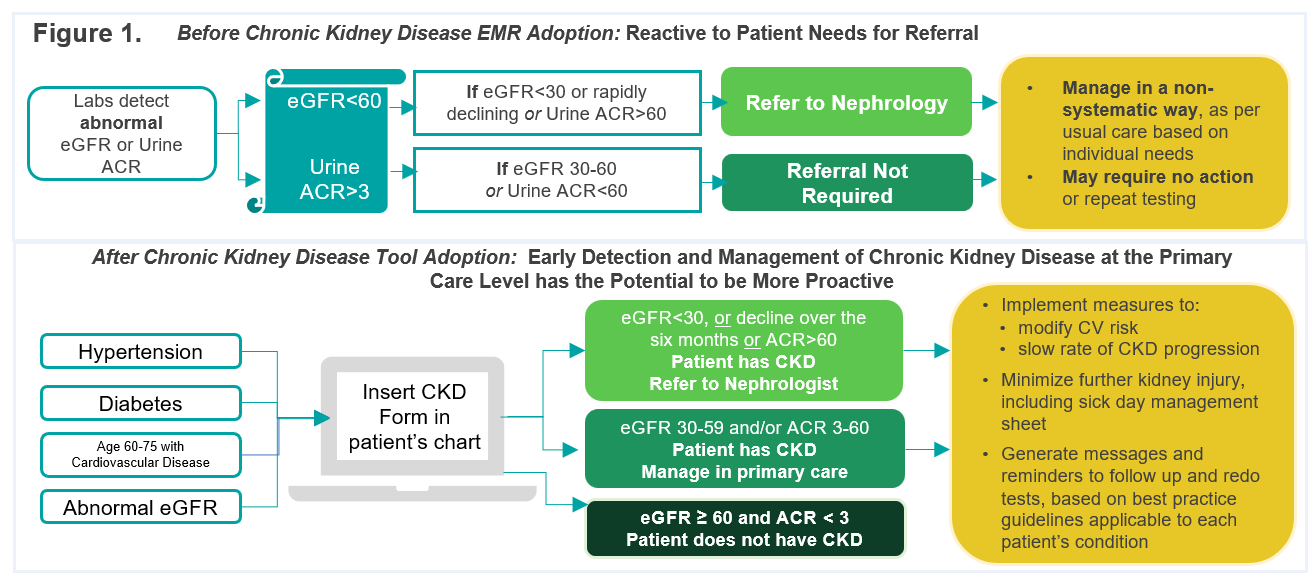

I was surprised to see the large number of patients at moderately increased risk, who I would have attributed as having declining renal function simply based on age but who I needed to monitor more carefully and counsel on sick day management including withholding drugs which may worsen renal function. This would help in reducing the risk of further renal decline and potentially prevent a referral to a nephrologist or even hospitalization.
I was also able to identify several high risk individuals who needed a referral to nephrology and who also needed counselling on sick day management and avoidance of nephrotoxic drugs. This EMR tool really helped me understand that both eGFR and ACR are needed to diagnose chronic kidney disease, and to identify patients requiring referral to nephrology or just monitoring on my own. The tool provides easy tabs on the lab requisition for the appropriate tests as well as the ability to generate reminder messages regarding when labs are due again.

Dr. Upe Mehan
Centre for Family Medicine Family Health Team
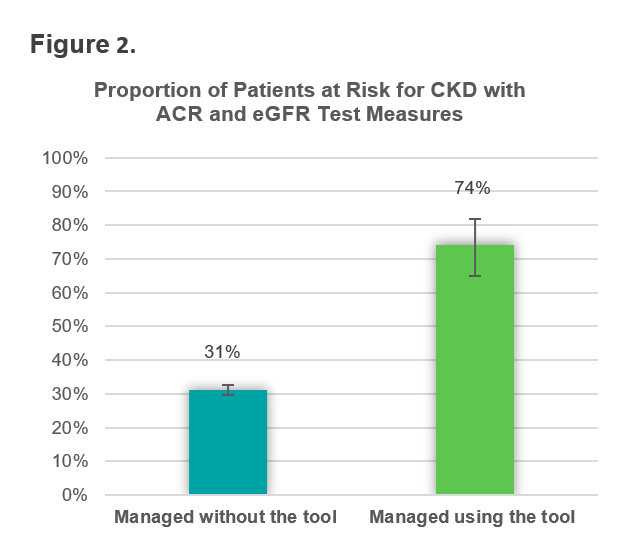
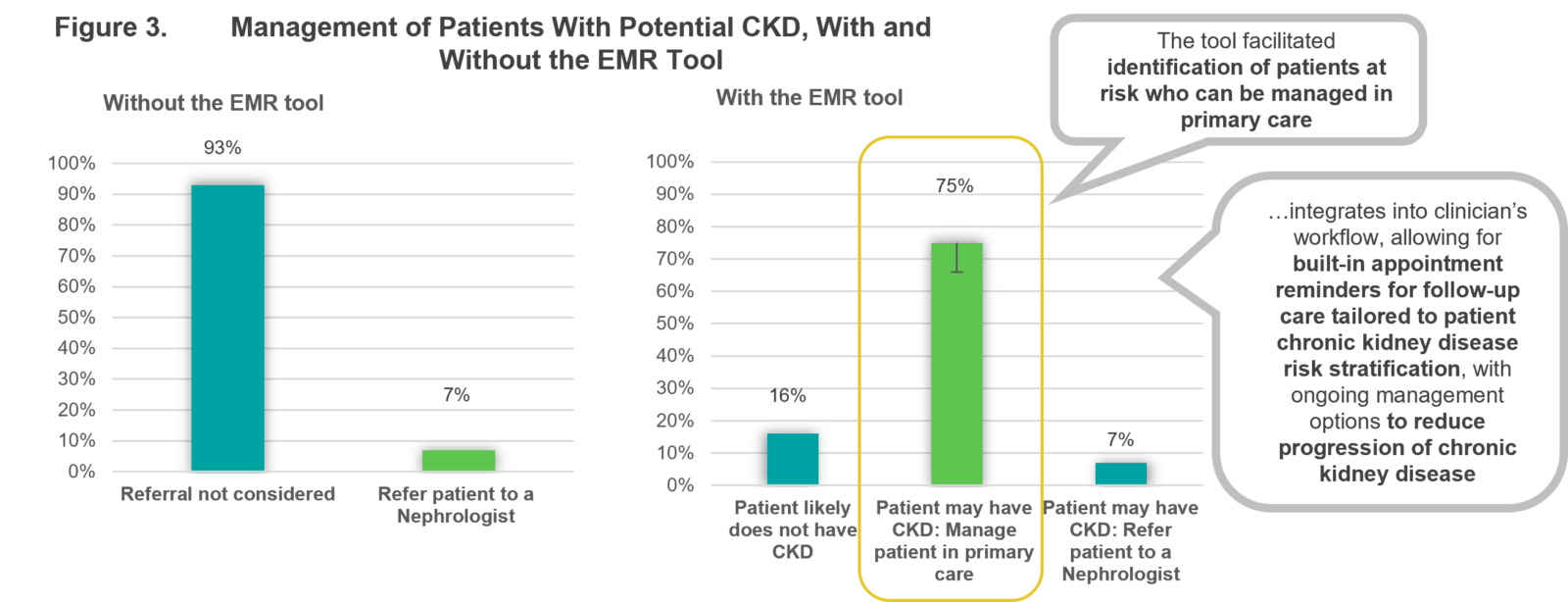
An analysis of EMR data from a clinic that has adopted the tool illustrated that patients at risk for chronic kidney disease managed by the tool are significantly more likely (p<0.01) to have both ACR and eGFR measures as recommended, compared to patients managed without the Chronic Kidney Disease EMR tool (74% vs. 31%, respectively; Figure 2). The use of both eGFR and ACR values to detect chronic kidney disease allows for a more enhanced stratification of risk, identifying more individuals at risk that are not captured using the eGFR and ACR parameters separately, prior to electronic medical record tool adoption (Figure 3).
The Chronic Kidney Disease EMR tool enables the primary care clinician to feel more confident managing patients with chronic kidney disease, and that the referral to nephrology meets the Ontario Renal Network guidelines and is hence more likely to be accepted in a timely manner.
Works Cited
- 1.Arora, P., Vasa, P., Brenner, D., et al. (2013). Prevalence estimates of chronic kidney disease in Canada: results of a nationally representative survey. CMAJ. 185(9):E417–23.
- Lloyd, A., and Komenda,P. (2015) Optimizing care for Canadians with diabetic nephropathy in 2015. Can J Diabetes, 39(3): 221-8.
- Ontario Renal Network. (2015). Introduction to KidneyWise Clinical Toolkit.
Interested in learning more?
Interested in partnering with us or learning more about
what we can offer you? Please reach out here.
Get the latest resources and insights
-

Webinar on EMR inbox management: recording available
Sharing some tips, tricks, and key takeaways from our first-ever Ideal Primary Care Practice Model…
-

Erie St. Clair and South West: Cataract Central Intake One Year Post Go-Live
The St. Joseph’s Health Care London Cataract Central Intake (CCI) went live in April 2024.…
-

Burnout Is Real. Your Professional Development Shouldn’t Add to It.
We’re excited to share that Shield is now accredited for up to 12.5 Mainpro credits,…
-
Health Information Network Provider (HINP) accountability statement eServices “eReferral”
Under PHIPA and for the purposes of the eReferral, The Centre for Family Medicine Care…