



Case Study: Exploring the Impacts of the Central Waitlist Management System in Northwestern Ontario
Key Takeaway
The Central Waitlist Management initiative, supported by eReferral integrations with waitlist management technologies, is advancing health equity in Northwestern Ontario.
Background
Residents of Northwestern Ontario face undue hardships in terms of accessing equitable, continuous and quality healthcare in comparison to the rest of the province. Geographically, Northwestern Ontario has the land-mass comparable to the country of France, with some areas of the Region having only fly-in or ice road access. A Centralized Waitlist Management system was needed to develop better referral management within the Northwestern Region. A Centralized Waitlist Management system ensures that referrals are appropriately prioritized based upon patient urgency levels and that patients are being referred to the most appropriate clinician. The Centralized Waitlist Management system alleviates a challenge associated with geographical distribution and management by allowing referrals to be digitally forwarded throughout the region, while also enhancing clinician-to-clinician communication. Without a Centralized Waitlist Management system in place, there were no other mechanisms to manage referral distribution or clinician load and to ensure patients can receive the care they need when they need it.
The Centralized Waitlist Management initiative began in 2018 for the orthopedics pathway, with expansion in 2019 to include multiple specialties, including spine, shoulder, foot and ankle care. Endoscopy, general surgery (for hernia and gallbladder), and limited gynecology were launched in 2021, and in 2023, chronic disease management care also went live. In 2024, specialty care, including ophthalmology, obstetrics, full gynecology, otolaryngology, and CT launched, with vascular, MRI, and pediatrics launching in 2025.
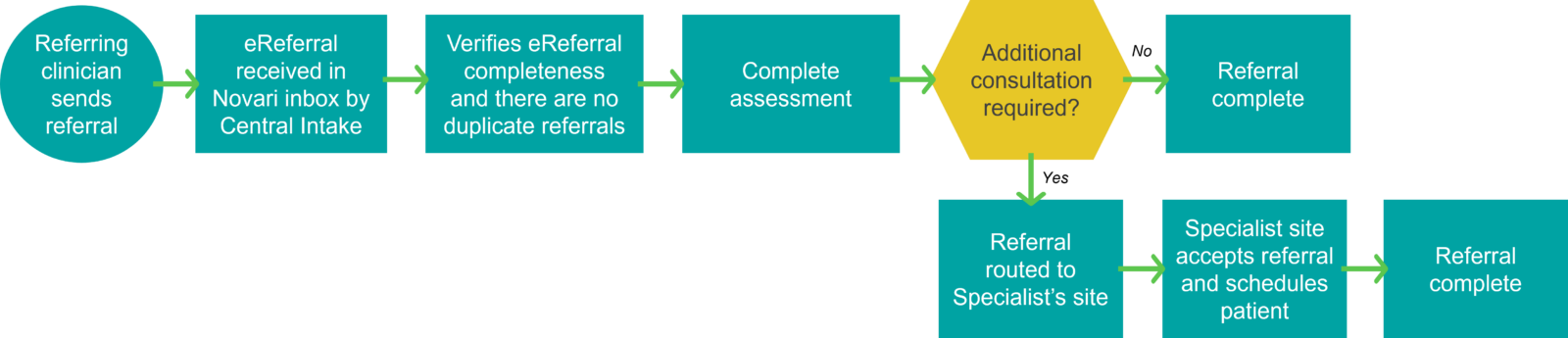
Centralized Waitlist Management has created a structured, patient-centred approach to referral and care management. This initiative transcends technological integration by emphasizing the vital human connections fostered through continuous change management efforts, with the engagement of both clerical and frontline staff being crucial to the initiative’s success. By prioritizing patient needs over a traditional “first-come, first served” model and responsibly utilizing scarce healthcare resources in remote areas, the Centralized Waitlist Management initiative, supported through eReferral integrations with waitlist management systems, has significantly enhanced equity and access to care for vulnerable populations in Northwestern Ontario. Below is a simplified visual representation of how referrals move throughout the Centralized Waitlist Management system.
Figure 1. CWM Workflow Visualization
Benefits of Centralized Waitlist Management in Northwestern Ontario
At the heart of the Centralized Waitlist Management initiative are the people of Northwestern Ontario, patients who are navigating a complex healthcare system that can often feel overwhelming and uncertain. For many, the traditional “first-come, first-served” model didn’t reflect the urgency of their medical needs. Centralized Waitlist Management has changed that. By prioritizing patients based on the severity of their conditions, the system not only improves access but also reduces the anxiety and frustration that can come with waiting for care. In a testimonial provided by the Thunder Bay Regional Health Sciences Centre team, one story that stood out to the team involved a patient referred for a serious orthopedic issue, and due to Centralized Waitlist Management, they were matched with a specialist and seen the very same day their referral was submitted. Previously, this might have taken days or even weeks. This story is one of many, and this kind of timely, equitable care represents a major step forward for the region and serves as a reminder of why this work matters.
Centralized Waitlist Management has also brought greater clarity and efficiency to the referral process. Historically, incomplete referrals have been a significant risk, leading to delays and improperly prioritized referrals. But since Centralized Waitlist Management was implemented, the Thunder Bay Regional Health Sciences Centre team noted that incomplete referrals received by the Central Intake dropped noticeably. When information is missing, clerical staff can quickly request updates through secure messaging, which means no more phone tag or waiting on faxes. Real-time updates – that are date and time stamped – means that everyone involved in a patient’s care is on the same page, every step of the way. Additionally, duplicate referrals can be caught at the intake level, minimizing time wasted on dual work streams.
Another important improvement has been the ability to better utilize available appointment times. Previously, missed appointments or cancellations often resulted in wasted time. Now, with access to a live list of clinicians and openings, Central Intake staff can reallocate referrals quickly and efficiently, ensuring no available care goes unused.
An equally important part of the Centralized Waitlist Management approach is helping patients get care closer to home whenever possible. With a regional view of clinician availability, Central Intake staff can route referrals to the nearest site with the appropriate specialist, minimizing unnecessary travel and supporting better continuity of care. For communities across Northwestern Ontario, many of which are remote or underserved, this has been a significant improvement in how healthcare is accessed.
As Northwestern Ontario has shown, Centralized Waitlist Management is not just a technical improvement, it is a real step toward a more patient-centred, accessible healthcare system. It means shorter waits for the most urgent needs, fewer barriers to complete referrals, and, whenever possible, care that is closer to home. Together, these changes are not just system wins; they are real improvements that impact the lives of patients and families every day.
Technology Enabling an Efficient Central Intake
The success of the Centralized Waitlist Management initiative is made possible by Novari technology, which provides the digital backbone for an efficient, transparent, and patient-safe Central Intake model. By centralizing referrals, Novari ensures that every referral is visible, trackable, and actively managed by giving Central Intake staff eyes on each patient’s journey so no one falls through the cracks.
Integration with the Ocean eReferral platform further strengthens this model by enabling real-time referral updates and secure, two-way communication between referring clinicians and Central Intake. This seamless digital connection eliminates delays associated with traditional fax-based workflows and allows missing information, clarifications, or status updates to be addressed quickly and efficiently. As a result, referrals move through the system with greater accuracy, transparency, and speed while aligning with the provincial goal of “Axe the Fax”.
Novari also enables referrals to be routed digitally and re-routed as needed without relying on paper, faxes, or manual workarounds. Whether reallocating a referral due to clinician availability, patient location, or urgency, Central Intake staff can seamlessly redirect referrals multiple times within the system while maintaining a complete audit trail. This flexibility is critical in a region as large and complex as Northwestern Ontario, where access to care must adapt to changing circumstances.
In addition to operational efficiency, Novari provides comprehensive, customizable data on referral patterns across the region. Using configurable filters, teams can analyze trends related to volume, referral indication, service demand, and geographic distribution. This data-driven insight supports continuous improvement, informed planning, and more equitable resource allocation, helping the system respond proactively to both current and emerging needs.
Together, these capabilities transform Central Intake from a passive referral repository into an active coordination hub. Novari technology enables visibility, accountability, and responsiveness at every stage of the referral process, ensuring that patients are prioritized appropriately, providers are better utilized, and care is delivered more efficiently and equitably across Northwestern Ontario.
Acknowledgements
The development and creation of this case study was possible due to the incredible insights and hard work from the North West Deployment Team and the Thunder Bay Regional Health Sciences Centre Team. Thank you to these teams for meeting to discuss the impacts and workflow of the Centralized Waitlist Management, and your review of this case study. A special thank you to Caroline Fanti (Program Director for Thunder Bay Regional Health Sciences Centre).
Interested in learning more?
Interested in partnering with us or learning more about
what we can offer you? Please reach out here.
Get the latest resources and insights
-

Work With HEAL to Identify the Workflow Challenges That Matter Most
Amplify Care’s Healthcare Experience and Advancement Lab (HEAL) invites clinicians and their care teams to…
-

From Idea to Solution: Get Hands-On with Our Vibe Coding Workshop for Primary Care
Amplify Care’s Healthcare Experience and Advancement Lab (HEAL) is hosting a free, in-person workshop where…
-
 Clinicians, Efficiency, Medical Imaging, Perceived Impact, Sending Referral Workflows, Standardized eReferral Forms
Exploring the Impact of the Medical Imaging Standardized eReferral Form on Clinician Efficiency and Timing of Sending eReferrals
A case study that looks at patient experience with eReferral in Ontario: surveys indicate an…
-

Creating Capacity in Primary Care: Big Impact Can Happen through Small Changes
The second guest post in a two-part series from Kathy Irwin, Integrated Care Manager at…